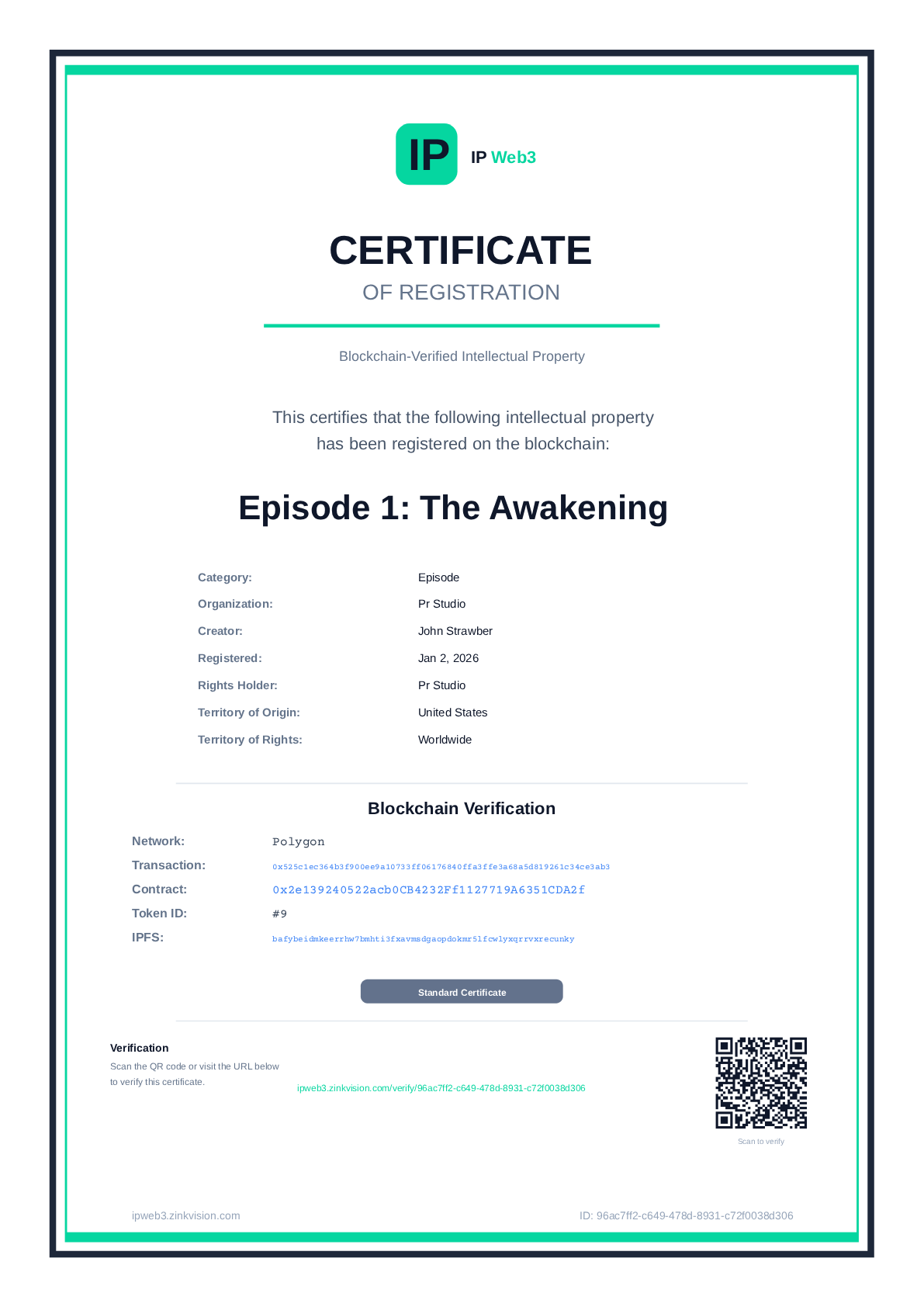
No wallets. No crypto. No lawyers required upfront. Upload your creative work and we register it on-chain with a court-recognized timestamp. The same flow whether you protect one file yourself or hand a whole catalog to us.
We built this so you never have to think about the technical side. Ever.
Log in and upload the files you want to protect. Art, music, code, writing, characters, series bibles, scripts, any creative asset. We accept all common formats.
Your files go into a private, encrypted space. Nothing is public. Only the cryptographic fingerprint is ever stored on-chain.
Our team verifies metadata and checks file integrity before anything goes on-chain, so your proof is clean and complete.
You get a notification when review is complete, usually within the hour for creators. If we need anything, we reach out directly.
We register your IP on-chain. A cryptographic fingerprint of your file is permanently written alongside metadata and a qualified timestamp. We handle all the crypto, you never need a wallet.
Your original file is stored permanently on IPFS, a decentralized network that cannot be taken down, modified, or deleted.
The content hash is embedded in your on-chain record, creating an unbreakable link between the on-chain proof and your original file.
You receive a downloadable PDF with your registration details, a QR code linking to the public verification page, and a qualified timestamp for EU legal recognition.
Every record has a permanent public verification URL. Share it with clients, lawyers, or partners as proof of ownership and creation date.
All your protected work in one place, organized and shareable with anyone who needs to verify your ownership. Studios also get licensing and revenue tools in a dedicated portal.
If you made it, we can register it.
Timestamp originals before sharing with clients or posting online.
Prove when your track, beat, or composition was created.
Seal your thesis, papers, or discoveries with a verifiable date.
Immutable proof an NDA, proposal, or contract existed on a date.
Register source code and prototypes before filing patents.
Protect scripts, storyboards, and footage with timestamped proofs.
Seal blueprints, CAD files, and technical drawings before sharing.
Prove ownership of photos before publishing or licensing them.
Document inventions, business plans, and prototypes with a date.
Character sheets, concept art, and original design documents.
Full bibles, episode outlines, and show treatments.
Finished episodes, rough cuts, and animatics.
Style frames, background art, and visual assets.
Animated sequences, motion tests, and final renders.
Screenplays, episode scripts, and shooting scripts.
Short films, feature cuts, and final deliverables.
Multi-episode series and seasonal production packages.
Pitch decks, one-pagers, and investor presentations.
Pilot episodes, proof-of-concept videos, and demos.
Panel sequences, shot lists, and visual narratives.
World-building visuals, mood boards, and explorations.
No. We handle wallets, gas fees, and transactions. You use a normal dashboard, never a blockchain.
No. An NFT is a tradable token built to be owned and transferred. IPWeb3 registers an immutable, timestamped record of your file on-chain, proving you created it in that exact form on a specific date. The value is the permanent proof of authorship, not a token to trade.
Yes. Your files go into a private, encrypted space. Only a cryptographic fingerprint is ever stored on-chain. Nothing is public unless you choose to share it.
Creators get proof in minutes. For studio submissions, review takes 1-2 business days, then the on-chain step completes in minutes and you get your record the same day.
Any digital file: images, PDFs, videos, ZIP archives, scripts, 3D files. If you can upload it, we can register it.
Our EU Legal records include an eIDAS-qualified timestamp, the same standard used for digital contracts and court submissions across the EU. It proves your file existed at a specific time.
The original registration is permanent and cannot be changed. That is what makes it trustworthy. You can register updated versions as new entries, which creates a clear version history.
On-chain timestamps work as supporting evidence in disputes. Courts in the US, EU, and China have accepted on-chain evidence as admissible. In the EU, eIDAS recognizes qualified electronic timestamps as legally valid. The most common use is proving your work existed first in licensing or ownership disputes.